
EuroLeague 2025/26: How the New Rules Could Change Playing Style and Match Tempo

The EuroLeague season of 2025/26 started with a clear message from organisers: the competition wants cleaner behaviour, fewer stoppages, and more consistent officiating. Several targeted rule updates — particularly around technical fouls, bench conduct during fast breaks, and expanded Instant Replay System (IRS) usage — may look minor on paper, but they can meaningfully influence pace, late-game decision-making, and even how coaches manage risk. Below is a practical breakdown of how these changes can reshape the rhythm of games and the tactical choices teams make.
1) Stricter Technical Fouls: Less “Negotiation” With Referees
One of the biggest behavioural shifts comes from the removal of warnings before technical fouls for inappropriate behaviour and for faking/flopping. In previous seasons, players and coaches sometimes pushed right up to the line, expecting a warning first. With that buffer reduced, a single emotional reaction, demonstrative complaint, or clear exaggeration of contact can now have an immediate cost on the scoreboard.
From a style perspective, this encourages teams to stay more disciplined — not because “sportsmanship” suddenly becomes fashionable, but because the risk is immediate and measurable. Players who build their defensive identity around physical pressure and theatrical reactions may have to adapt quickly, especially in high-stress fourth quarters when tension is at its highest.
In terms of tempo, fewer prolonged debates and fewer “warning moments” should reduce dead time. While free throws from technical fouls do stop the clock, the overall aim is to stop repeated stoppages caused by ongoing protests. If teams accept decisions faster, the match flow becomes more continuous, and the game feels quicker even if possessions per game rise only slightly.
How Teams May Adjust Player Behaviour and Defensive Discipline
Coaches are likely to demand more controlled body language — especially from primary ball-handlers and defensive anchors who are most involved in contact situations. Expect captains and veterans to become more active as “on-court moderators,” pulling teammates away from officials and preventing emotional spirals that lead to technical free throws.
Defensively, the flopping element matters. EuroLeague has long been physical, but exaggerated reactions were sometimes used as a tool to influence whistle tendencies. With the new approach, defenders who rely on selling contact may become more selective, prioritising verticality and positioning over performance. This could reward teams with disciplined footwork and strong containment principles.
There’s also a roster-management angle. Players with a history of frequent technical fouls might see shorter leashes. In close games, a single technical can swing momentum, so rotations may become slightly more conservative — favouring calmer decision-makers in crunch time.
2) Bench Conduct and Fast Break Protection: A Direct Push Toward Speed
Another rule update targets a very specific tempo-killer: people from the bench entering the court during a fast break. Under the new standard, coaches are automatically disqualified if they or any registered bench member steps onto the court in a fast break situation. This is not a soft deterrent — it’s a decisive punishment that will make bench areas far more cautious.
EuroLeague games often swing on transition moments, and even minor interruptions can remove a clear scoring chance. By introducing automatic disqualification in this scenario, the organisers are protecting fast breaks as one of basketball’s most valuable “speed elements.” If fast breaks are less likely to be disrupted, teams may feel more confident pushing tempo after rebounds, steals, and long outlet passes.
This also changes how coaches manage emotion. The classic moment of stepping slightly onto the floor while protesting a call becomes more dangerous, especially when the ball is live and an opponent is running. That means fewer theatrical sideline reactions and less chaos near the court — both of which can contribute to a smoother viewing experience and fewer delays.
What It Means for Transition Offence, Pressing, and Coaching Style
Teams that already play at pace — using early offence, rim runs, and quick hit-aheads — may benefit most. If transition scoring chances are better protected, the expected value of pushing increases. That can subtly shift the balance away from slow, half-court control and toward opportunistic running after defensive stops.
Pressing and trapping may also become more attractive. If fast-break continuity is safeguarded, then forcing turnovers has even greater potential reward. Some clubs may invest more minutes into aggressive defensive schemes designed to create live-ball steals, knowing the league is actively discouraging interference that breaks transition flow.
For coaches, it’s a behavioural reset. Staff will likely establish stricter bench protocols: designated areas, clearer communication rules, and stronger accountability for assistants. Even a momentary lapse from an assistant stepping forward can now carry massive consequences, so discipline becomes part of match preparation — not a side detail.
3) Expanded Instant Replay System (IRS): More Precision in the Final Minutes
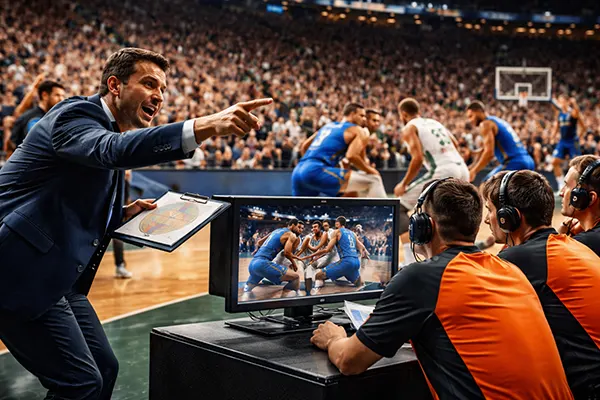
The 2025/26 updates also expand the IRS in two meaningful ways: eight-second violations can be reviewed by referees in the final two minutes of the fourth quarter and overtime (if the violation was called), and coaches can challenge those calls at any point in the game. In addition, referees may now use IRS to review foul identity — confirming the correct player who committed the foul if there’s potential recording error.
At first glance, replay tools can sound like a threat to tempo because reviews take time. However, EuroLeague’s approach is targeted. The eight-second review window is limited to the last two minutes of regulation and overtime, where the value of each possession is highest and a single mistake can decide the outcome.
What this changes most is late-game strategy. Teams protecting a lead often use ball pressure to force eight-second violations, while trailing teams try to break pressure quickly. With reviewability, both sides must be more exact. A marginal eight-second call becomes less “final,” and coaches must decide whether spending a challenge is worth the possible swing in possession and momentum.
How Late-Game Tactics and Coaching Risk Management Could Shift
Expect endgame possessions to become more structured. Ball-handlers under pressure will likely prioritise safe advancement patterns — such as stagger screens and deep outlets — because a reviewed eight-second call can become a pivotal moment. Teams may drill press breaks more intensively, knowing that the last two minutes can now include high-stakes reviews.
Coaches will also handle challenges differently. Since eight-second violations can be challenged at any point (as long as the call exists to challenge), some teams may use early challenges to protect momentum, while others will save them for crunch time. This creates a psychological layer: opponents may press harder if they believe the other coach has already spent the challenge.
Foul identity review reduces “stat sheet chaos” and can prevent unfair foul trouble when the wrong player is recorded. That may indirectly affect tempo as well: if a team avoids mistakenly benching a key player due to a recording error, rotations stay stable, and the match remains tactically coherent rather than disrupted by confusion.