Mondo Duplantis vs Emmanouil Karalis: Historic Pole Vault Duel Above Six Metres in Lausanne
Men’s pole vault reached a remarkable new level in Lausanne on 20 August 2026 when Mondo Duplantis and Emmanouil Karalis turned the Athletissima City Event into a contest unlike any previously recorded. Duplantis won with 6.21 metres, while Karalis cleared 6.16 metres to finish second, making this the first competition in which two men had both gone beyond 6.10 metres. The numbers alone made the evening significant, but the way the contest developed gave it greater importance. Neither athlete was simply chasing a high mark after the result had already been settled. Karalis remained close enough to keep genuine pressure on the world record holder, forcing the bar upwards until Duplantis produced one of the highest clearances of his career. In a discipline where six metres has traditionally separated exceptional vaulters from the rest, Lausanne showed that the leading pair of 2026 were beginning to compete on an even more demanding scale.
A Lausanne Contest That Changed the Scale of Men’s Pole Vault
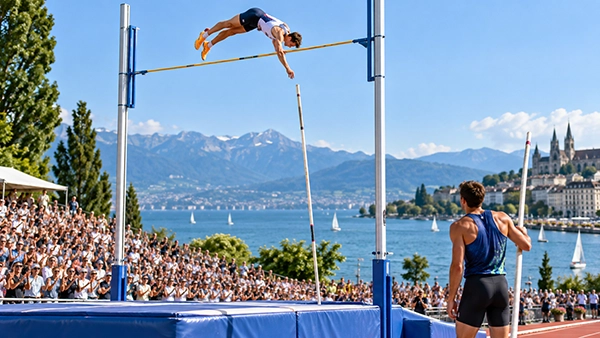
The men’s pole vault was staged as Athletissima’s City Event at the Place de la Navigation on the shores of Lake Geneva, a setting that had already become closely associated with high-level vaulting. More than 5,000 spectators watched a field containing several established international athletes, including Kurtis Marschall, Sondre Guttormsen, Christopher Nilsen, Ernest John Obiena and Sam Kendricks. Yet the competition gradually became a direct contest between Duplantis and Karalis. Both athletes moved through the earlier heights confidently, and by the time the bar reached six metres there was a clear separation between the leading pair and most of the field. The open city setting also gave the competition a different atmosphere from a conventional stadium meeting, with spectators positioned close to the runway and landing area as the two leading vaulters moved into territory rarely reached even at major championships.
The first major turning point came at 6.00 metres. Duplantis and Karalis both reached that height with perfect records and required only four jumps each to get there. A six-metre clearance remains an important distinction in men’s pole vault, even during an era in which Duplantis has repeatedly pushed the world record higher. For two athletes to arrive there without a failure meant neither had surrendered an advantage through missed attempts. It also allowed the competition to move quickly towards heights that would decide more than the meeting victory. Once both men had cleared six metres, the evening was no longer centred on whether they could reach an elite benchmark. The question became how far above it they could go while competing directly against one another.
The next stage was particularly unusual. A height of 6.11 metres had initially been prepared, but with the rest of the field out of contention, Duplantis and Karalis moved directly to 6.16 metres. Duplantis cleared it at his first attempt, improving the Athletissima mark he had established with 6.15 metres in Lausanne in 2024. Karalis missed his opening attempt but responded on his second, producing a 6.16-metre outdoor personal best. That clearance changed the character of the contest once again. Duplantis could not simply rely on his earlier first-attempt advantage and finish the evening at the existing meeting record. Karalis had matched the height and remained close enough to require another response from the Swede.
How the Bar Moved from 6.00m to 6.21m
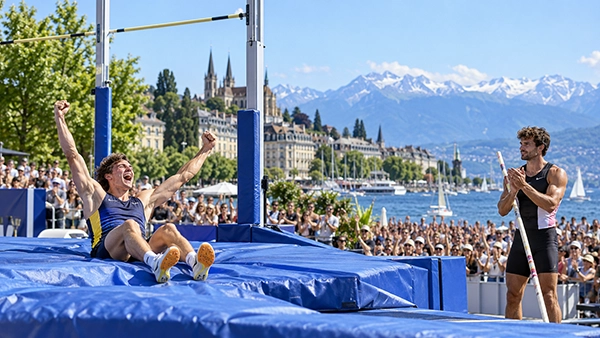
Duplantis answered immediately when the bar was raised to 6.21 metres. He cleared the height at the first attempt, maintaining a perfect record throughout his progression to the winning mark. Karalis was unable to follow him beyond 6.16 metres, leaving Duplantis with first place and another Lausanne record. The five-centimetre difference between them may appear comfortable on paper, but that does not fully describe the contest. Karalis had already reached a height that only Duplantis had surpassed more consistently, and his presence at 6.16 metres meant the world record holder had been required to clear 6.21 metres rather than simply ending the competition after securing victory at a more routine height.
With the win secured, Duplantis raised the bar to 6.32 metres. That height carried a clear purpose: it was one centimetre above the 6.31-metre world record he had set indoors in Uppsala on 12 March 2026. He made two attempts before ending his competition without taking a third. The record therefore remained at 6.31 metres, but the decision to move directly from 6.21 to 6.32 reflected the level at which Duplantis was operating. A clearance above 6.20 metres was no longer automatically the final objective of his evening. When conditions and form allowed, the next target was another world record. Lausanne did not provide that record, yet the 6.21-metre winning height still stood as an exceptional result.
The rest of the standings help put the duel into perspective. Marschall, Guttormsen and Nilsen all cleared 5.91 metres, with placings decided by their previous attempts. That is a strong international standard, yet it left a 25-centimetre gap between the best of the chasing group and Karalis at 6.16 metres, while Duplantis finished another five centimetres higher. Obiena, Zachery Bradford and Kendricks reached 5.81 metres. In other words, Lausanne was not a weak competition inflated by two unusually high marks. Several accomplished vaulters were involved, but Duplantis and Karalis operated at a level of their own once the bar passed six metres.
Why Karalis Could Push Duplantis Further Than Before
Karalis arrived in Lausanne with evidence that his rise towards the very top of the event was no temporary run of form. At the Paris 2024 Olympic Games he had taken bronze with 5.90 metres, and at the 2025 World Championships in Tokyo he moved up to silver after clearing 6.00 metres. His progress accelerated further in 2026. On 28 February in Athens, he cleared 6.17 metres indoors, establishing the best mark of his career at the time and placing himself second on the men’s all-time list behind Duplantis. That performance changed the context of every subsequent meeting between them. Karalis was no longer approaching six metres only on his best days; he had demonstrated that he could move well beyond it and remain competitive at heights previously reached by only a very small number of vaulters.
Lausanne was also familiar territory for the Greek athlete. In August 2025, with Duplantis absent from the men’s City Event, Karalis had won at the same lakeside location with 6.02 metres. He achieved that clearance in difficult rainy conditions and earned his first Diamond League victory. Returning one year later therefore meant competing at a venue where he already had a successful history above six metres. The 2026 conditions were more favourable, and this time the strongest possible opponent was present. Karalis responded by improving his outdoor best to 6.16 metres. Although he did not win, the performance represented a much greater competitive step than his victory at 6.02 metres a year earlier because the bar continued rising under direct pressure from Duplantis.
The difference between the two athletes in Lausanne was not consistency at the lower heights but Duplantis’s ability to keep producing first-attempt clearances when the competition moved past 6.10 metres. He reached 6.16 and 6.21 without a miss. Karalis needed a second attempt at 6.16 and could not follow at the next height. That distinction mattered, but it was far narrower than in many earlier contests involving the Swede. Instead of Duplantis winning and then continuing alone against a record, another athlete remained involved deep into the six-metre range. For spectators, that created a genuine head-to-head contest rather than two separate phases consisting of a competition for first place followed by Duplantis’s individual pursuit of a record.
Two Careers Meeting at a New Competitive Level
Duplantis entered 2026 with a record that already placed him in a category of his own. He had won Olympic gold in both Tokyo and Paris, and by September 2026 his collection also included three outdoor world titles and four world indoor titles. His ability to increase the world record repeatedly had changed expectations around the event, with heights once regarded as extraordinary becoming familiar targets whenever he competed. The 6.31-metre mark set in Uppsala in March 2026 extended that progression again. For rivals, therefore, defeating Duplantis was not simply a matter of producing a career best close to six metres. On many occasions it required reaching heights that would have been among the greatest performances in history before his era.
Karalis had already shown only four days before Lausanne that he could remain close deep into an important championship. At the 2026 European Athletics Championships in Birmingham, Duplantis won his fourth successive European title with a championship record of 6.15 metres, while Karalis secured silver at 6.00 metres. The Greek athlete also attempted 6.10 metres and came close on one of those efforts. Their meeting in Lausanne therefore followed almost immediately after another competition in which they had occupied the top two positions. The difference was that Lausanne allowed Karalis to turn his six-metre form into a much higher clearance, moving from 6.00 in Birmingham to 6.16 just four days later.
That rapid sequence explains why the Lausanne contest became more important than a single outstanding evening. Duplantis remained the athlete with the higher personal best, the world record and the stronger championship record, but Karalis was producing enough six-metre performances to make repeated confrontations competitive. His 6.17-metre indoor best had already demonstrated his maximum level, while 6.16 outdoors in Lausanne showed that such heights could be approached in major summer meetings as well. The gap between them still existed, particularly when Duplantis was clearing above 6.20, but by August 2026 it was small enough for the next bar to matter whenever both arrived at six metres without major errors.
What the Lausanne Duel Meant for Pole Vaulting in 2026
The clearest historical feature of Lausanne was straightforward: never before had two men cleared more than 6.10 metres in the same competition. Duplantis had spent years moving far beyond that mark, but usually without another athlete remaining alongside him at comparable heights. Karalis changed that pattern at the Place de la Navigation. His 6.16 metres meant Duplantis’s 6.21 was not simply another dominant winning mark; it was part of a contest in which two vaulters simultaneously reached territory that had once been occupied by isolated performances from the greatest names in the discipline. That made the evening important not only for their personal records but also for the wider standard of the event.
The competition also illustrated how the meaning of a six-metre clearance had evolved. Six metres remains difficult and relatively rare, but for the leading athletes of 2026 it could no longer be treated automatically as a winning mark. In Lausanne, both Duplantis and Karalis went comfortably beyond it. One week later in Zurich, a third athlete, Sondre Guttormsen, would clear exactly 6.00 metres and still finish behind both of them. This does not make six metres ordinary; rather, it shows how strong the top end of men’s pole vault had become. The most successful athletes were beginning to separate themselves not simply by reaching six metres, but by how far beyond six metres they could continue.
Lausanne also showed that a historically significant pole vault contest did not require the setting of an Olympic or World Championship final. Athletissima placed the event beside Lake Geneva, close to the public and outside the main stadium programme, yet the competitive standard remained exceptional. Duplantis’s 6.21 metres improved the best mark achieved at this type of off-stadium City Event, while Karalis produced his outdoor personal best in the same competition. The crowd was therefore watching meaningful sporting history rather than an exhibition. The combination of an accessible urban setting and elite results gave the contest a distinctive place in the 2026 season without changing the basic sporting measure that mattered most: the heights cleared by the athletes.
The Rivalry Continued After Lausanne
Lausanne was not the highest point of their head-to-head season for long. On 27 August in Zurich, only a week later, Duplantis cleared 6.25 metres and Karalis reached 6.20 metres for the first time in his career. Guttormsen finished third with 6.00 metres. The Zurich result strengthened the pattern established in Lausanne: Duplantis still had an answer when Karalis produced a major personal performance, but the Greek athlete was moving closer to the range above 6.20. For Karalis, reaching 6.20 was another important barrier broken. For Duplantis, clearing 6.25 demonstrated that he could respond without needing a world-record attempt to define the quality of his performance.
The Diamond League Final in Brussels on 4 September produced a different chapter. Duplantis withdrew shortly before the competition because of tightness in his leg, leaving Karalis as the leading contender. The Greek vaulter took the opportunity, winning the final with a meeting record of 6.12 metres and securing his first Diamond League title. His victory was significant because it added a major season-long trophy to the personal bests and podium finishes he had already accumulated. It was not a direct defeat of Duplantis, as the Swede did not compete, but it confirmed that Karalis could take responsibility for the competition and deliver beyond six metres when the main title was available.
The pair met again at the World Athletics Ultimate Championship in Budapest on 11 September. Duplantis returned to winning form with 6.20 metres, while Karalis finished second after clearing 6.15 metres. That result closely resembled the pattern seen in Lausanne: both athletes reached exceptional heights, but Duplantis retained the decisive advantage above 6.15. As of mid-September 2026, his 6.31-metre world record from Uppsala remained intact, while Karalis’s season had established him as the closest regular challenger at the highest levels. Lausanne stands at the centre of that story because it was the evening when their competition first produced two clearances above 6.10 metres and showed, in measurable terms, how far the standard of men’s pole vault had risen.