UFC 330: Islam Makhachev Defends Title Against Ian Machado Garry and Sets New UFC Record
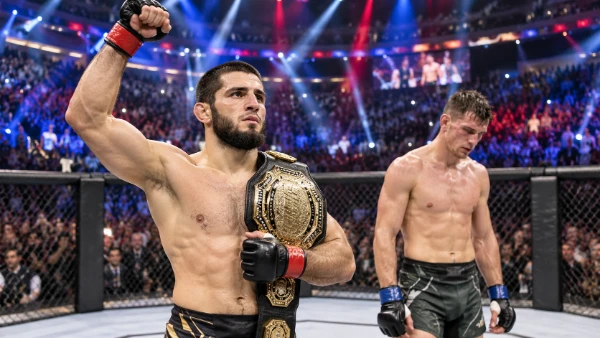
Islam Makhachev made UFC history on 15 August 2026, defeating Ian Machado Garry by unanimous decision in the main event of UFC 330 at Xfinity Mobile Arena in Philadelphia. The Dagestani champion retained his welterweight title after five competitive rounds, earning scores of 49-46, 49-46 and 48-47. More importantly, the victory extended his winning streak to 17 consecutive UFC fights, surpassing Anderson Silva’s long-standing record of 16. The contest tested Makhachev’s wrestling, striking and endurance against an ambitious Irish challenger who refused to surrender control without a fight. It was Makhachev’s first defence of the welterweight championship and another significant achievement in a career that already included a successful reign at lightweight.
UFC 330 Main Event: Makhachev Overcomes Machado Garry in Five Rounds
The welterweight championship bout was the centrepiece of UFC 330, marking the organisation’s return to Philadelphia for the first time since 2019. Makhachev entered as the reigning champion, having moved up from lightweight and captured the 170-pound title by defeating Jack Della Maddalena at UFC 322 in November 2025. His challenger, Ian Machado Garry, arrived as the division’s number-one contender with a professional record of 17 victories and just one defeat. Both fighters successfully weighed in at 170 pounds, setting up a meeting between two contrasting approaches to mixed martial arts.
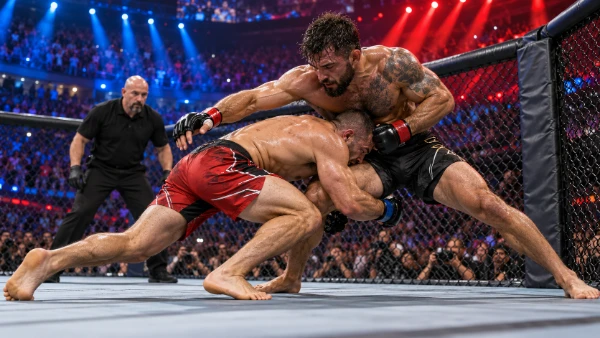
Makhachev began the contest by imposing his familiar wrestling pressure. During the opening round, he closed the distance, took Garry to the canvas and restricted the Irishman’s opportunities to establish a striking rhythm. Garry’s height, reach and movement presented difficulties, but the champion repeatedly sought close-range exchanges where he could control his opponent’s positioning. The second round produced one of the fight’s most important moments when Makhachev connected with a right hand and a left high kick from the clinch, briefly sending Garry to the floor. The exchange demonstrated that the champion’s threat extended beyond his renowned ground game.
The balance shifted during the third round as Garry began finding more success with his punches and kicks. His movement helped him create space, while Makhachev appeared to slow after the demanding opening exchanges. The fourth round brought another adjustment from the champion, who returned to his wrestling and completed several takedowns despite Garry continuing to land effective strikes. With the fight still competitive heading into the final five minutes, Makhachev secured another takedown, moved behind the challenger and maintained back control until the final horn. All three judges awarded him the victory, confirming his first successful welterweight title defence.
Why Makhachev’s Wrestling Made the Difference Against Garry
The contest illustrated why Makhachev remains one of the most difficult opponents to defeat in the UFC. His wrestling does more than produce takedowns: it forces opponents to spend energy defending attacks, recovering their footing and preventing dominant positions. Garry regularly attempted to remain mobile and create striking opportunities, but the threat of being taken down influenced how freely he could attack. Even when the Irishman found success standing, he had to account for Makhachev’s ability to change the direction of the contest through grappling. This constant pressure became particularly important as the championship rounds approached.
Garry nevertheless demonstrated considerable improvements in his defensive wrestling. The challenger resisted prolonged control at several stages and proved capable of returning to his feet against an opponent known for dominating experienced fighters on the canvas. His success in the third round showed that Makhachev could be challenged when exchanges remained standing. Garry also continued to land meaningful strikes in the fourth, preventing the champion from enjoying uninterrupted control. Although these moments were insufficient to secure the decision, they highlighted the Irishman’s ability to compete at championship level and exposed areas that future opponents may attempt to exploit.
The decisive difference emerged in the fifth round, when Makhachev secured the position he needed to protect his advantage. Rather than pursuing a risky finish, he maintained control from behind and prevented Garry from generating the offence necessary to change the result. That decision reflected his awareness of the scorecards and the importance of preserving positional dominance in a close contest. The final scores also indicated that the challenger had remained competitive throughout the fight. Makhachev won through a combination of early success, timely wrestling and disciplined control rather than the overwhelming domination associated with some of his previous championship performances.
Islam Makhachev Breaks Anderson Silva’s Historic UFC Winning Streak
Makhachev’s victory at UFC 330 established a new record for consecutive wins in UFC history. His 17th straight triumph moved him ahead of former middleweight champion Anderson Silva, whose 16-fight winning streak had stood as one of the organisation’s most celebrated achievements. Silva accumulated those victories between 2006 and 2012, building a reputation for extraordinary striking and memorable championship performances. Makhachev reached the new milestone through a different combination of skills, relying heavily on wrestling, positional control and increasingly effective striking. Their careers belong to different periods of the sport, but both streaks demonstrate remarkable consistency against elite opposition.
The record becomes even more impressive when considering the opponents Makhachev defeated during his rise. His lightweight championship reign included victories over Charles Oliveira, Alexander Volkanovski and Dustin Poirier, all established names with extensive experience in major UFC contests. He defeated Volkanovski twice, successfully defended his lightweight title on several occasions and later pursued a second championship in a heavier division. Moving from 155 to 170 pounds introduced opponents with different physical advantages, particularly in reach, strength and natural fighting weight. Winning the welterweight championship and defending it against Garry showed that Makhachev could remain successful after making that transition.
Following UFC 330, Makhachev held a professional record of 29 wins and one defeat, including an 18-1 record inside the UFC. His only professional loss came against Adriano Martins in October 2015, when he was stopped by punches in the opening round. Since that setback, Makhachev has steadily developed into one of the sport’s most accomplished competitors. The 17-fight sequence is particularly notable because it includes championship contests, difficult stylistic match-ups and victories across two weight classes. Although comparisons between different generations remain subjective, the numerical record gives Makhachev a measurable achievement that no previous UFC fighter had matched.
How Makhachev Became One of the UFC’s Most Successful Two-Division Champions
Makhachev first became UFC lightweight champion at UFC 280 in October 2022, submitting Charles Oliveira in the second round. The victory confirmed his position among the leading fighters at 155 pounds and began a championship reign built on victories over increasingly demanding opponents. He successfully defended the belt against Alexander Volkanovski twice before submitting Dustin Poirier at UFC 302 and Renato Moicano at UFC 311. These results demonstrated his ability to finish dangerous opponents as well as control longer contests. His lightweight achievements established the foundation for his eventual decision to pursue another title rather than continue defending the same championship indefinitely.
The move to welterweight became a defining stage of his career. At UFC 322 in November 2025, Makhachev defeated Jack Della Maddalena by unanimous decision to claim the 170-pound championship. The result made him a UFC champion in two separate weight divisions, joining a distinguished group of fighters who had achieved that distinction. His subsequent victory over Garry carried additional historical significance. Makhachev became the fifth two-division UFC champion to successfully defend titles in both weight classes, joining Daniel Cormier, Amanda Nunes, Henry Cejudo and Jon Jones. Winning a second belt is difficult, but defending championships in different divisions provides stronger evidence of sustained success.
Another important aspect of Makhachev’s career is his ability to adapt without abandoning the methods that made him successful. His connection with the Dagestani wrestling tradition remains central to his fighting style, while his striking has become more confident and varied over time. Opponents must prepare for takedowns, submissions, pressure against the fence and dangerous exchanges on the feet. The Garry fight was not flawless, but it demonstrated how Makhachev could make adjustments when a challenger disrupted his preferred approach. At 34 years old during UFC 330, he had accumulated enough championship experience to recognise when patience and control offered a better chance of victory than pursuing an immediate finish.
UFC 330 Results, Championship Implications and What Comes Next
UFC 330 featured another championship defence in the co-main event, where Mackenzie Dern defeated Gillian Robertson by unanimous decision to retain the women’s strawweight title. The judges scored the five-round contest 49-46, 49-46 and 48-47, giving Dern her first successful defence since capturing the vacant championship at UFC 321 in October 2025. The contest brought together two accomplished grapplers, with Robertson entering as an established submission specialist. Dern’s victory strengthened her standing in the division and reinforced her position among the leading female fighters in the organisation. Both championship bouts lasted the full 25 minutes, although the earlier main-card contests produced considerably quicker finishes.
The remaining main-card results included three stoppage victories. Jalin Turner knocked out Kauê Fernandes after just 39 seconds of the opening round, delivering the quickest finish of the main card. Dustin Stoltzfus submitted Mansur Abdul-Malik with a rear-naked choke at 4:25 of round two, securing an important middleweight victory. Esteban Ribovics defeated experienced Brazilian striker Edson Barboza by technical knockout at 1:32 of the second round. Ribovics applied aggressive pressure and repeatedly landed damaging punches before the referee stopped the contest. Following the defeat, Barboza placed his gloves in the centre of the Octagon, signalling the end of his lengthy UFC career.
The preliminary contests also delivered several notable performances. Charles Johnson submitted Eduardo Chapolin with an unusual twister submission in the third round, while Jeremiah Wells defeated Myktybek Orolbai by guillotine choke at 1:24 of round three. Neil Magny stopped Ramiz Brahimaj by technical knockout in the second round, and Donte Johnson secured a first-round knockout against Eric McConico. Tresean Gore earned a unanimous decision over Vicente Luque, Chidi Njokuani defeated Joel Álvarez on the judges’ scorecards, and Lucas Fernando stopped Rafael Tobias in the third round. With two championship fights and a mixture of knockouts, submissions and competitive decisions, the event provided significant results across several weight divisions.
What the UFC 330 Result Means for Makhachev and the Welterweight Division
Makhachev’s successful title defence strengthened his position at the top of the welterweight division and created an important challenge for potential contenders. His record-breaking winning streak makes every future championship appearance historically significant, while his ability to compete successfully against larger opponents increases the difficulty of finding a suitable challenger. Fighters seeking to defeat him must develop reliable takedown defence without sacrificing their offensive striking. Garry demonstrated that movement, distance management and timely combinations could cause problems, but he was unable to maintain those advantages for five complete rounds. Future opponents will need to build on those lessons while avoiding prolonged periods of control on the canvas.
For Ian Machado Garry, the defeat represented a setback rather than the end of his championship ambitions. His professional record moved to 17-2, but his performance confirmed that he could remain competitive against one of the sport’s strongest champions. At 28 years old during the event, the Irish fighter still had considerable time to improve his wrestling defence, develop his approach to championship rounds and pursue another opportunity. His ability to challenge Makhachev in standing exchanges was encouraging, particularly after the champion had controlled much of his previous welterweight title victory. A return to winning form against other leading contenders could strengthen Garry’s case for another title fight.
The result also carries broader significance for Makhachev’s place in UFC history. Seventeen consecutive victories, championships in two divisions and successful defences at both lightweight and welterweight represent an exceptional combination of achievements. His performance in Philadelphia was not his most dominant, yet it showed an equally important quality: the ability to win when a capable opponent creates unexpected difficulties. Makhachev left UFC 330 as the reigning welterweight champion and the sole holder of the organisation’s longest winning streak. Whether he can extend that record will depend on future opponents and championship opportunities, but his victory over Garry has already secured a lasting place in the UFC record books.